Fallow Deer

Pankaj Singh
| 13-04-2026
 · Animal Team
Imagine a deer so adaptable it has lived on every continent except Antarctica, so beautiful it was kept in royal parks for centuries, and so socially complex it holds group debates before making decisions.
Meet the fallow deer — Dama dama — a creature hiding extraordinary secrets behind its elegant, spotted coat.
A Coat That Rewrites Itself Every Season
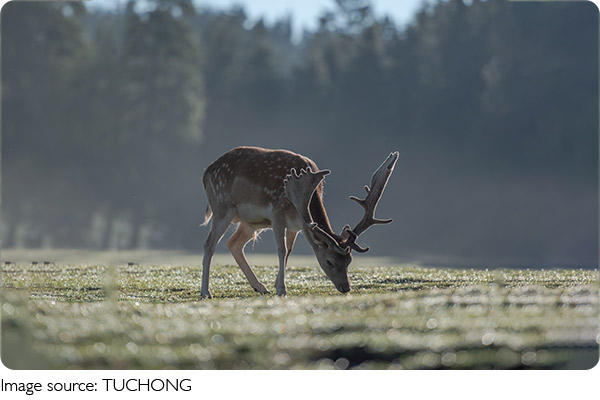
Most people recognize the fallow deer by its distinctive dappled summer coat — rich chestnut brown scattered with white spots across the back and flanks. But what few realize is that this coat transforms dramatically through the year. By winter, the spots fade almost entirely, replaced by a uniform grey-brown that provides entirely different camouflage in bare woodland. A single deer essentially wears two different disguises annually, shifting its appearance with the precision of a seasonal wardrobe change driven by hormones and daylight length.
What makes this even more remarkable is that fallow deer exist in at least four recognized color variations within the same wild population:
1. Common — chestnut with white spots in summer 2. Menil — paler, retaining spots year-round 3. Melanistic — very dark brown to near-black 4. Leucistic — creamy white, often mistaken for albino
These variations are not separate subspecies. They can all appear within the same herd, born to the same parents.
Antlers That Are Genuinely Unique
Among all deer species, fallow deer possess one of the most architecturally distinctive antler forms: the palmate antler. Unlike the branching tines of red deer or the simple spikes of roe deer, mature fallow bucks develop broad, flattened antler heads resembling an open hand — the word "palmate" comes directly from the Latin for palm. These structures can span up to 70 cm across and are shed and completely regrown every single year. The regrowth cycle, driven purely by changing daylight hours, produces roughly 2.5 cm of new antler tissue per day during peak growth — one of the fastest-growing tissues in the entire animal kingdom.
The Rut: A Theatrical Performance
Each autumn, fallow deer engage in one of the natural world's most dramatic social spectacles — the rut. Bucks gather in traditional display grounds called "leks" and establish territories sometimes no larger than 30 square meters. There, they vocalize constantly with a distinctive deep groaning belch, thrash vegetation with their antlers, and walk in parallel lines beside rival males in highly ritualized parallel walks — a behavior that allows each buck to assess the other's size and strength without immediate physical confrontation. Only when this assessment fails to resolve a standoff does genuine sparring occur. It is, in every meaningful sense, a negotiation.
Surprisingly Strong Swimmers
Despite their refined appearance, fallow deer are powerful swimmers and will readily cross rivers, lakes, and coastal channels when necessary. Island populations have established themselves across the British Isles, parts of Australasia, and Mediterranean islands — many arriving without any human assistance, crossing open water to colonize new habitat. Their hollow hair structure, which traps air, provides natural buoyancy far beyond what their slender legs might suggest.
Ancient Survivors With a Complex History
Fallow deer are not native to most of the places they now inhabit. Their original range was the eastern Mediterranean and Middle East. They survived the last Ice Age in isolated refugia, then spread across Europe partly through natural movement and partly through deliberate human introduction stretching back to Phoenician and Roman traders who prized them for ornamental parks. Medieval European nobility kept them in enclosed deer parks as symbols of prestige. Today, established wild populations exist across:
1. The British Isles and much of continental Europe 2. Australia and New Zealand 3. South Africa and parts of South America 4. Various Mediterranean islands
Herd Intelligence and Collective Decision-Making
Recent behavioral research has revealed that fallow deer herds make movement decisions collectively rather than following a single dominant individual. When a group is ready to move to a new grazing area, individuals begin standing and orienting in the intended direction. Once a threshold — roughly 51% of the herd — aligns toward the same direction, the whole group moves together. It is, effectively, a democratic vote conducted through posture.
The fallow deer rewards careful attention in a way that many more celebrated animals do not. Look past the prettiness of those spots, and you find a creature of genuine complexity — one that negotiates conflict through ritual, votes on destinations, reinvents its appearance twice a year, and has outlasted civilizations that once kept it in walled gardens. Perhaps the quiet ones always have the most interesting stories.